

The Project
The Solar Commons Project has created the legal and community governance tools for a new, commons-based model of community solar ownership to be implemented throughout the US.
The twenty-first century energy transition will generate billions of dollars in energy savings from long lasting solar technologies. Our goal is to ensure that these savings can be pooled and stay in the hands of local communities to build community wealth. We work in “living labs” with community partners who use our legal and digital peer governance dashboard tools to transparently monitor and share solar energy savings through twenty-year community trusts. We are making available a free, robust solar commons toolkit so that, just as the sun shines for everyone, the sun’s common wealth can be claimed and distributed by civil society groups building local, sustainable livelihoods. As globalized economic systems weaken, solar commoning will be known as a trustworthy, local revenue source and a resilient community-scale economic institution.
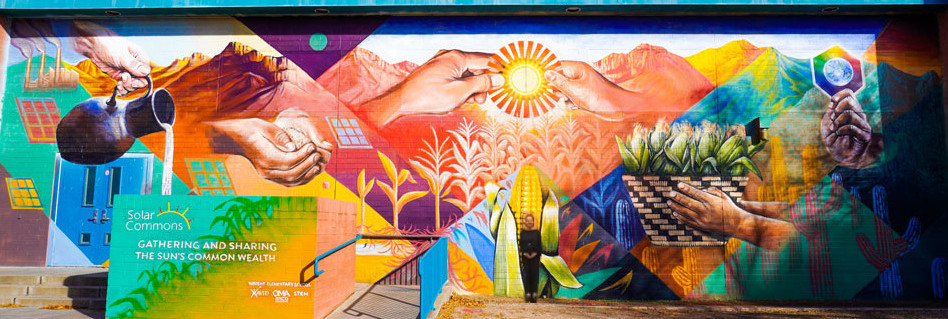
Solar Commons Mural in the schoolyard of the Trust Beneficiary Neighborhood (Wright Elementary School, Tucson, AZ), our First Solar Commons Project. Artist: Karlito Espinoza 2020. For a sense of the mural’s scale, the Founder-Director of the Solar Commons Project, Prof. Kathryn Milun, is standing in the corn. Solar commoning neighborhoods use public art to make visible their place-based claim to the sun’s common wealth.
School Solar Commoning
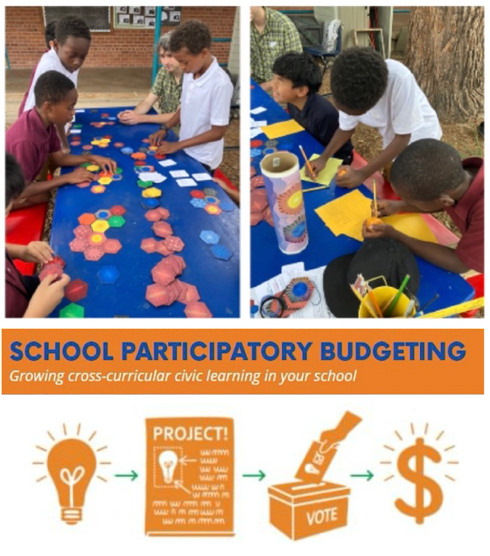
Our first two Solar Commons prototypes are with schools. In Tuscon, Arizona and northern Minnesota, our Solar Commons legal agreements are testing schools as the long-term community stewards of the common wealth trust funds. Schools use the civic tool of participatory budgeting to annually share the wealth in their neighborhoods for community benefit. We created an interactive game to introduce the idea of commons to the school children. In the game, the players take turns selecting cards that contain scenarios about cooperating with nature, neighbors, and community.
By placing tiles, the players build their own neighborhoods while learning about social resiliency, environmental responsibility, and sharing the sun’s commonwealth. In Arizona, the schoolyard mural ties in themes of the Solar Commons game. In Minnesota, the game includes Ojibwe language elements and land-based teachings. School solar commoners use our digital dashboard to track solar savings going to the trust and engage citizen science curriculum. The dashboard makes visible the sun’s solarity next to data from other types of place-based common wealth such as air quality, water quality and, in northern MN, the health of wild rice (Manoomin).
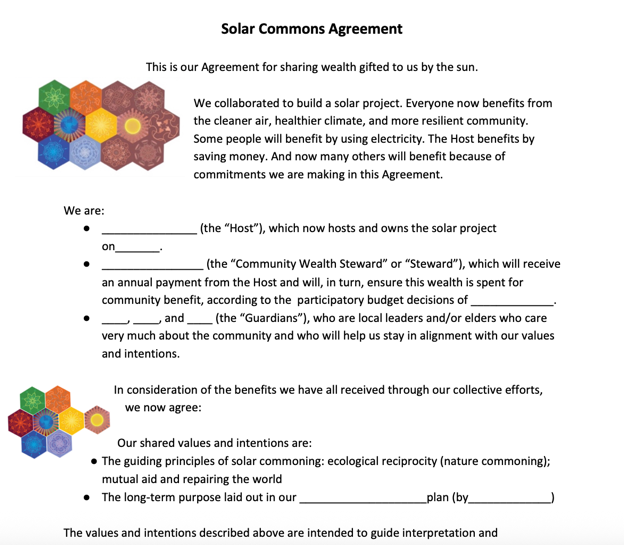
Lawyer: Janelle Orsi
Artist: Dorsey Kaufmann
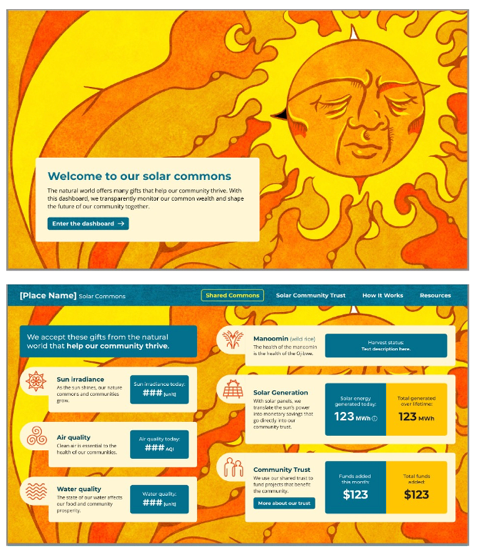
Artist: Moira Villiard
Value and Scalability Studies
The Solar Commons Project embeds solar technology in social and ecological relationships that support equitable local livelihoods for low-income communities in rural and urban regions. Research from Rocky Mountain Institute (RMI) has demonstrated the capacity of the Solar Commons Model to iterate across the US within the span of a decade. RMI found that the Solar Commons could produce a positive net present value to donors as it proliferates across the US. Read the RMI Solar Commons Financial Analysis here or the RMI Solar Commons Scalability Analysis here.
Research Team
The Solar Commons Project is hosted by the Minnesota Design Center at the University of Minnesota’s College of Design. The project is led by legal anthropologist Prof. Kathryn Milun. who collaborates with community and university researchers from several disciplines including law, public art, architecture, engineering, economics, and computer science.
Partners
From hot and cold climates, our partners work with the research team on Solar Commons legal, economic, and governance tools. Partners include community and tribal groups in Minnesota and Arizona as well as the University of Arizona School of Art, the Sustainable Economy Law Center in California, and the solar manufacturing company Heliene, Inc. in Minnesota. Learn more about our partners.
Funders
This Project has been supported by financial contributions from many: the US Department of Energy which awarded the Tucson Solar Commons a “Sunny Award for Equitable Community Solar.” In Arizona we received grants from the Pulliam Charitable Trust, the Lodestar Foundation and the US Green Building Council (Arizona Chapter). In Minnesota, the Institute on the Environment at the University of Minnesota and the MN Department of Commerce Solar on Public Buildings Program and others. Learn more about our funders.
Connect
This work involves a growing network of collaborators. If you would like to learn more or explore collaboration, please email Prof. Kathryn Milun or call +1-218-726-7071.